
Fill-Ins · Word Fit Puzzles
Razzle PuzzlesWord
4.74.45K Reviews
- Version
- 1.49
- Installs
- 1.00M
- Age Rating
- Everyone
Screenshots
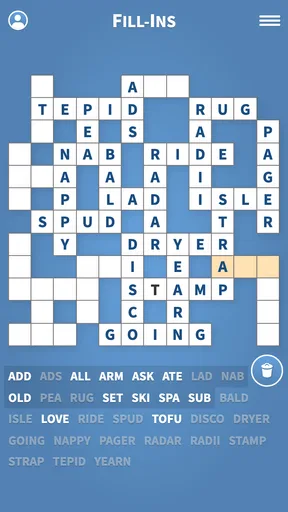
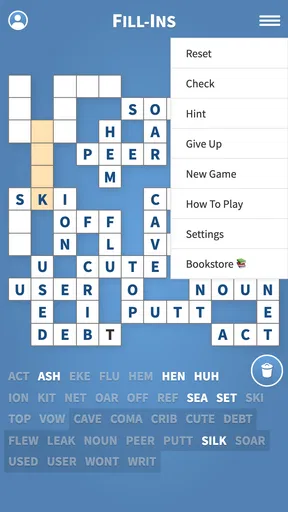
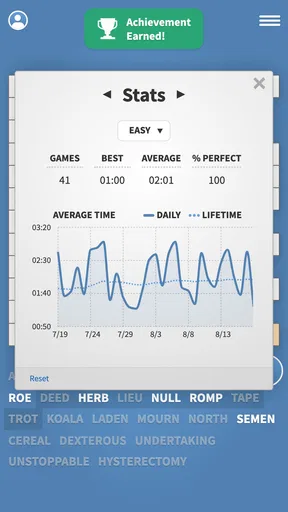
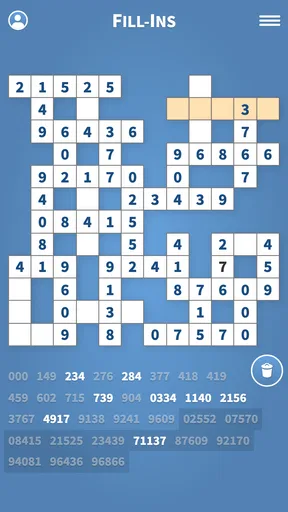
Our Review of Fill-Ins · Word Fit Puzzles
 Analysis by Appyee
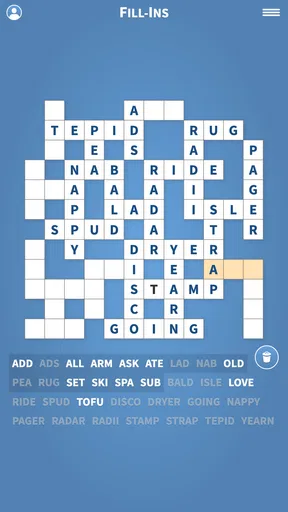
Fill-Ins · Word Fit Puzzles is the kind of word game I open when I want something quiet, focused, and easy to understand within a few seconds. Instead of asking me to solve a traditional clue, it gives me words and a crossword-style layout where each entry has to fit the available spaces. That small change makes the experience feel more like a logic puzzle than a vocabulary test, although knowing common words still helps. Developed by Razzle Puzzles, it is free to play, rated for Everyone, and belongs to the word-game category.
After spending time with it, I found that its main appeal is its clean mental rhythm. I can make progress quickly when the answers are familiar, then slow down and use the crossing letters when a word is less obvious. There is no need to learn a complicated control scheme or remember a story. The entire experience is built around placing words accurately, spotting patterns, and deciding when to stop forcing an answer and approach the grid from another direction.
How the puzzle feels in everyday use
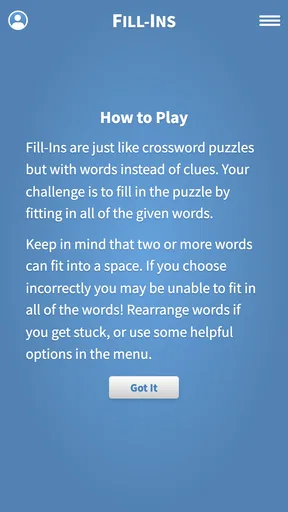
The opening moments are especially approachable. I do not have to study a long explanation before beginning, because the basic task is visible in the puzzle itself: find a word that matches a row or column and make sure the letters work with the crossing entries. That makes it suitable for a short break, a waiting room, or a few minutes before bed. The game can also hold my attention longer when I want a more deliberate session.
One realistic use is a morning commute as a passenger. I can start a puzzle, fill in the obvious short entries, and leave the difficult section for later without needing to remember a complicated objective. Another is a screen-free-feeling pause during a workday: the game gives my attention one contained problem instead of pulling me into a stream of notifications or competitive pressure. I would not describe it as completely effortless, though. Once several words intersect, a single mistaken assumption can make the rest of the grid feel confusing.
The strongest part of the design is the way certainty builds. I may recognize one word immediately, but its placement becomes more useful when it reveals letters for neighboring entries. That means an answer is rarely isolated. I often begin with the most obvious word, then use the resulting crossing letters to narrow down the choices elsewhere. This is more satisfying than simply guessing from a clue because the board itself gradually explains what belongs where.
The best solving habit is to treat every confirmed crossing letter as information, not just as progress. When I get stuck, I avoid repeatedly staring at the same empty space. Instead, I look for a partially supported word, place the entry that has the strongest evidence, and return to the original problem with a better pattern. This approach reduces random guessing and makes the game feel more like a sequence of small deductions.
Speed and the shape of a session
In ordinary use, the game feels designed for quick access rather than a long setup. A word puzzle should let me concentrate on the board, and Fill-Ins generally keeps that focus on the act of fitting words together. I can play slowly, checking the structure before committing, or move rapidly through the entries I know. The perceived speed therefore depends less on reflexes and more on how familiar the word set feels.
That distinction matters when comparing it with other word games. A timed word-search game rewards fast scanning, while a clue-based crossword asks me to retrieve an answer from a definition. This title sits between vocabulary and spatial reasoning. I spend less time interpreting a clue and more time testing whether a word belongs in a particular pattern. If I enjoy calm deduction, that is a strength. If I want urgency, competition, or a strong sense of escalating action, the experience may seem too restrained.
The game is also a good fit for people who dislike losing because they are slow. There is no need to race through a board to enjoy it. I can pause mentally, revisit the grid, and make progress at my own pace. On the other hand, players who prefer a clear countdown, a score chase, or a dramatic reward loop may find the steady format less motivating than a more competitive alternative.
What happens when the grid becomes difficult
The heavier moments are not about demanding graphics or complicated controls; they come from the amount of attention required when several entries are uncertain. A nearly completed section can still resist a solution if I have placed one plausible word in the wrong location. That is where the game tests patience. I have learned that a word can look correct on its own while being wrong for the grid, so I check its crossings before trusting it.
A useful workflow is to divide the board into confidence levels. I mentally mark entries that are certain, entries supported by most of their letters, and entries that are only guesses. I then work from the first group toward the second. This prevents a speculative answer from becoming the foundation for multiple other guesses. It is a small technique, but it makes larger or more tangled puzzles feel less overwhelming.
Another practical tip is to stop trying to solve in reading order. The top-left corner is not automatically the best place to begin, and moving line by line can waste time when the strongest clues are elsewhere in the layout. I scan for the word with the clearest pattern, fill it, and let the new letters guide the next choice. That makes the board feel more open and gives me a better chance of recovering from a stalled section.
For heavy use, the main trade-off is mental rather than technical. A long session can become repetitive if I play only when every answer is immediately familiar. I get more enjoyment by alternating between quick puzzles and slower ones, or by stopping after a satisfying breakthrough instead of continuing until the activity feels like work. The game is at its best as a flexible pastime, not as something I need to grind through for hours.
Reliability and recovering from a mistake
My impression of reliability is tied to the simplicity of the experience. The game has a focused purpose: present a fill-in word grid and let me work through it. There are no story chapters or elaborate systems that I need to keep track of before I can resume. That makes it easy to return to after a break, because I can understand the state of a puzzle almost immediately by looking at the letters already placed.
Recovery from a wrong turn is more important here than it may first appear. When a word does not fit the surrounding entries, I do not regard that as a failure of the whole puzzle. I treat it as a signal to revisit the least certain placement. The most effective correction is usually not to erase everything, but to identify the earliest assumption that caused the conflict. This keeps the solving process controlled and avoids turning one doubtful answer into a complete reset.
That recovery style is one reason I would recommend the game to someone who likes puzzles but does not want a harsh penalty for experimentation. It lets me think through alternatives instead of feeling that one mistake has ruined the session. Still, the experience requires honesty about uncertainty. If I keep filling spaces with guesses simply to make the board look fuller, I create more work for myself later.
The broad audience rating also makes sense to me. The premise is easy to explain, and the game does not depend on mature themes or specialized knowledge. Younger players can practice spelling and pattern recognition, while adults can use it as a low-pressure way to keep their attention engaged. The difficulty will still vary from person to person, especially for players who are less comfortable with English vocabulary or who prefer visual puzzles over word-based ones.
Device expectations and practical limits
Fill-Ins is not the sort of game I choose for visual spectacle. Its appeal comes from the board, the words, and the satisfaction of completing a connected arrangement. That means I would not install it for high-end graphics, animated worlds, or a demanding audio experience. I would choose it because the core activity is compact and understandable, making it a sensible option on a device that I mainly use for everyday tasks.
The stated minimum operating-system requirement is Android 6.0, and the current version is 1.49. That gives prospective players a clear compatibility checkpoint before installing. In practical terms, I would first check the operating system on an older phone or tablet rather than assuming that every aging device can run it. A compatible system does not automatically make every device equally comfortable, however; screen size, touch accuracy, and available storage can still affect how pleasant a word grid feels.
A larger display can make the board easier to inspect, especially when I am comparing several crossings at once. A smaller phone is more convenient for short sessions, but I may need to concentrate more carefully when the letters and spaces are tightly arranged. This is not a reason to avoid the game on a compact device, just a reminder that comfort depends on how easily I can read the whole puzzle without constantly shifting my attention.
I also see it as a relatively sensible choice for people who want a game that does not demand constant performance from the device. The activity itself is static and puzzle-focused rather than dependent on rapid animation or complex environments. I would still avoid making absolute claims about battery use or memory behavior across every phone, because those results depend on the device and its background workload. The important point is that the game’s value does not depend on powerful hardware.
Who should play it, and who should choose something else
I recommend it to players who enjoy word placement, cross-checking, and gradual problem solving. It is particularly suitable for someone who finds traditional crosswords intimidating because the task is more direct: the words are the material, and the challenge is fitting them into the right places. It also works for experienced puzzle fans who like the satisfaction of completing a grid without needing a timer or a story to provide motivation.
It may be a useful choice for families as well, provided everyone is comfortable with the vocabulary involved. A parent and child could discuss possible placements together, using the crossing letters to explain why one answer works better than another. That gives the game a small educational benefit without turning it into a formal lesson. I would not present it as a complete language-learning tool, though. It can reinforce spelling and recognition, but its central purpose is solving the grid.
I would point a different player toward another type of game if they want clues rich in general knowledge, an evolving campaign, or a strong multiplayer element. Someone who loves anagrams may prefer a game focused on rearranging letters, while someone who enjoys speed may get more satisfaction from a timed word challenge. Fill-Ins is not trying to serve all of those needs. Its identity is narrower, and that focus is both its appeal and its limitation.
The free price makes it easy to try without turning the decision into a major commitment. With a 4.7 average from around 16 thousand ratings and more than 1 million installs, it has clearly attracted a substantial audience. Those figures do not replace personal taste, but they do suggest that the straightforward format has broad appeal. I would still judge it by the kind of thinking I want from a game rather than by popularity alone.
How it compares with familiar word-game alternatives
Compared with a standard crossword, Fill-Ins reduces the emphasis on interpreting clues and increases the emphasis on placement. That can feel more accessible when I want to solve something without searching my memory for a precise definition. The trade-off is that players who love clever clue writing may find the experience less expressive. The pleasure comes from structure and consistency rather than from decoding a witty hint.
Compared with word searches, it asks for more planning. A word search lets me scan for a known sequence among distracting letters, while this game makes each answer affect other answers. I have to think about the board as a network, not just as a field where words can be spotted. That creates more satisfying chain reactions, but it also means that a careless placement can slow down the rest of the puzzle.
Compared with anagram games, it feels less frantic and more architectural. I am not simply trying to produce as many words as possible from a letter group. I am building a compatible arrangement in which every entry supports the surrounding entries. Players who enjoy taking one set of letters and generating many possibilities may find this less flexible, but I prefer it when I want a single problem with a clear internal structure.
That comparison also explains why I would keep it installed alongside other word games rather than treating it as a replacement for all of them. On a day when I want quick recognition, I may choose a word-search format. When I want a puzzle that rewards patience and revision, this is the better match. Its strength is not variety across every style; it is the focused satisfaction of making a whole grid agree.
My overall view after using it
Fill-Ins · Word Fit Puzzles succeeds because it understands the pleasure of a well-supported answer. I enjoy the moment when one certain word supplies the missing letters that unlock two more spaces, then those entries clarify the remaining section. The game does not need elaborate presentation to make that chain feel rewarding. Its best feature is the way the puzzle itself becomes the explanation.
There are clear limits. The format can feel repetitive if I need constant novelty, and players who want competition, narrative, or rapid action will probably be happier elsewhere. Vocabulary familiarity also affects the experience, so the same grid may feel relaxing to one person and frustrating to another. The game rewards a calm method, and it is less enjoyable when I approach every uncertain entry as something I must solve immediately.
For me, the performance verdict is positive because the design keeps the focus on a lightweight, readable word challenge rather than asking the device to do something elaborate. The Android requirement of 6.0 or later gives older-device users a useful compatibility reference, while the simple format makes it a practical companion for short or extended sessions. I would install it for quiet concentration, not spectacle.
Razzle Puzzles has made a free word game that is easy to start but capable of becoming surprisingly absorbing once the crossings get complicated. If you like fitting words into a logical structure, I think it is worth trying. My recommendation is strongest for players who appreciate patient deduction and want a game they can pick up, pause, and resume without losing the thread. If that sounds like your kind of break, Fill-Ins · Word Fit Puzzles offers a focused puzzle experience with enough depth to reward a thoughtful approach.
Verdict
Strengths of Fill-Ins · Word Fit Puzzles
- Offline play lets you solve puzzles without a constant internet connection.
- Clean interface makes the letter grid easy to read on smaller screens.
- Gradual difficulty suits both casual players and experienced puzzle fans.
- Short levels work well for quick breaks or daily brain-training sessions.
- Word placement encourages spelling, pattern recognition, and logical thinking.
Limitations of Fill-Ins · Word Fit Puzzles
- Some puzzles may feel repetitive after extended play sessions.
- Hints can reduce the challenge for players seeking a completely pure solve.
- Small letter tiles may be harder to use on compact phone displays.
- Progression may feel slow if you prefer fast unlocks and varied modes.
- Advertising can interrupt the experience in the free version.
Other Releases by Razzle Puzzles
View All
Similar Picks in This Category
View All
Word Search - Word Puzzle Game
Bluetile4.8

Word Search Quest - Puzzles
Blackout Lab4.8

CodyCross: Crossword Puzzles
Fanatee, Inc.4.7

Words of Wonders: Crossword
Fugo Games4.9

Wordscapes: Word puzzle game
PeopleFun4.7

Word Search Explorer
PlaySimple Games4.9
Frequently Asked Questions
What is Fill-Ins · Word Fit Puzzles?
Fill-Ins · Word Fit Puzzles is a word puzzle game based on fitting a provided list of words into a crossword-style grid. Instead of solving clues, you study the word lengths and crossing letters to determine where each word belongs. The game is designed for players who enjoy vocabulary challenges, logic, and relaxing puzzle sessions without the pressure of fast reflexes.
How do you play Fill-Ins · Word Fit Puzzles?
Each puzzle presents an empty grid together with a collection of words that must be placed into the correct horizontal and vertical spaces. You can begin with the longest or most distinctive words, then use crossing letters to narrow down the remaining possibilities. The objective is to complete the entire grid accurately, making it accessible to both casual players and experienced word-game fans.
Is Fill-Ins · Word Fit Puzzles suitable for beginners?
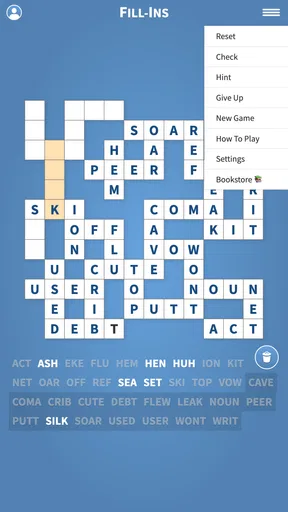
Yes, the game is generally suitable for beginners because it does not require knowledge of obscure clues or complicated rules. New players can learn the format after completing a few boards, while the increasing puzzle difficulty provides a longer-term challenge. If you become stuck, available assistance features may help reveal progress without requiring you to restart the puzzle.
Can I play Fill-Ins · Word Fit Puzzles offline?
Many puzzle games in this category support offline play once their content has been loaded, which makes them convenient for travel, commuting, or areas with limited connectivity. However, features such as advertisements, synchronization, updates, leaderboards, or in-app purchases may require an internet connection. Check the current store listing and test the game offline after installation for the most accurate result.
Does Fill-Ins · Word Fit Puzzles contain ads or in-app purchases?
The availability of advertisements and optional purchases can depend on the version of the app, your platform, and the developer’s current monetization settings. Free downloads may include ads between puzzles or offer paid options for removing them, obtaining hints, or unlocking additional content. Before downloading, review the Google Play or App Store listing and the purchase details shown on your device.
Play our best games!


